
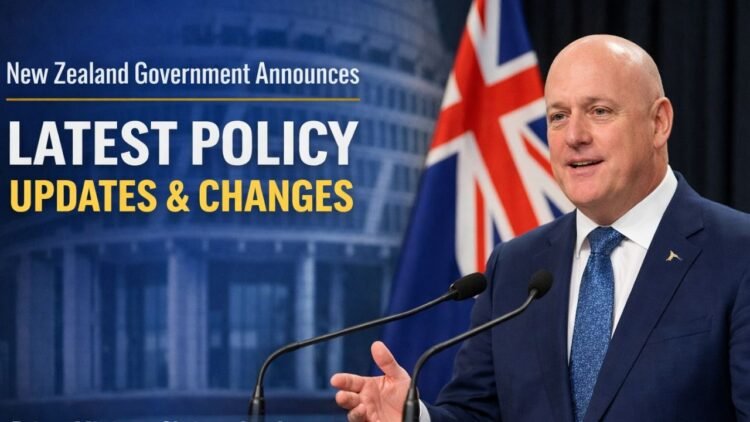
In 2026, the New Zealand Government has confirmed an important set of fresh policy changes that affect immigration, employment conditions, wage levels, social support systems, and government compliance standards.
These updates are being implemented in phases throughout the year, with major shifts from April 20, 2026, for visa and employment rules and from early 2026 for minimum wage changes and ongoing policy adjustments across social support and compliance frameworks.
These policy changes aim to create greater clarity for migrants, improve employment rights and responsibilities, strengthen compliance in social systems, and align wage levels with evolving economic needs.
Key Areas of Policy Changes
The confirmed policy shifts cover several significant domains that impact workers, migrants, employers, and recipients of government support:
- Open Work Visa Employment Conditions
- Minimum Wage Adjustment
- Social Support and Compliance Reforms
- Administrative and Documentation Procedures
Together, these changes reflect the Government’s focus on fair employment, rule enforcement, and clearer regulatory frameworks for residents and temporary visa holders.
Detailed Policy Changes
| Policy Area | Previous Situation | Confirmed 2026 Changes |
|---|---|---|
| Open Work Visa Rules | One general condition for open work visas | Two structured employment conditions from 20 April 2026; clarity on permitted work types |
| Minimum Wage | $23.15/hour (approx.) | Increase to NZD $23.95/hour from 1 April 2026 |
| Employment Compliance | Standard employment rules | Strengthened understanding of rights and responsibilities for visa holders |
| Social Support Reviews | Flexible benefit reviews | More systematic enforcement and clearer compliance checks |
| Business and Employer Visas | Employer‑linked visas unchanged | Employer‑specific visas remain outside open work visa adjustments |
| Digital Communication | Mixed methods | Increased reliance on digital notices and document tracking |
Open Work Visa Employment Conditions Explained
From 20 April 2026, the New Zealand Government will enforce new structure and clarity around open work visa conditions. Previously, open work visas generally allowed holders to work for any authorised employer without a job offer. Under the new policy, every open work visa holder must meet one of two distinct employment conditions:
1. Open Work Visas Allowing Any Work
Certain visa categories will allow holders to undertake any lawful work in New Zealand. This includes:
- Employment for any employer
- Self‑employment or working as a sole trader
- Owning and operating a business (subject to general business law compliance)
This category typically includes visas such as:
- Partner of a Worker Work Visa
- Post Study Work Visa
- Partner of a Student Work Visa
- Partner of a New Zealander Work Visa
- Partner of a Military Work Visa
2. Open Work Visas Requiring Employment for an Employer
Other visa categories will require that holders work only under an employment agreement or a contract for services (considered employment). These conditions apply to visas including:
- Working Holiday Visas
- Victims of Domestic Violence Work Visa
- Asylum Seeker Work Visa
- Migrant Exploitation Protection Work Visa
Under these conditions, visa holders cannot operate a business or be self‑employed. However, transitional arrangements allow current visa holders to continue existing work until their visas expire.
Both categories maintain the requirement that holders must comply with New Zealand’s employment and business laws at all times.
Minimum Wage Increase
To align wages with cost‑of‑living and economic changes, the minimum wage in New Zealand is confirmed to rise to NZD $23.95 per hour from 1 April 2026. This affects employers and work visa applications, such as the Accredited Employer Work Visa (AEWV), where wage offers must match the updated minimum rate.
Social Support and Administration Reforms
In addition to immigration and employment updates, 2026 policy changes include enhanced compliance and review mechanisms for various social support systems. These reforms focus on systematic documentation, benefit review processes, and digital communication to ensure accuracy and reduce unintentional non‑compliance.
The New Zealand Government’s 2026 policy changes are comprehensive and affect multiple areas of public and economic life. The most significant shifts are in open work visa employment conditions, which now require clear definitions of permitted work, and in the minimum wage increase, which rises to NZD $23.95 per hour.
Additionally, tighter social support compliance and digital notice systems aim to modernise administrative procedures for residents and temporary migrants alike.
These confirmed changes provide greater clarity but also require individuals, employers, and visa holders to stay informed and adjust to updated conditions.
FAQs
When do the new open work visa conditions take effect?
The updated open work visa conditions come into force on 20 April 2026 with two defined employment condition categories.
What is the new minimum wage in New Zealand for 2026?
Effective 1 April 2026, the national minimum wage will increase to NZD $23.95 per hour.
Do employer‑specific work visas change under these policies?
No. Employer‑specific work visas like the Accredited Employer Work Visa are not affected by the updated open work visa employment condition rules.